Strategy to pick strategies: the BCG strategy palette
By Anshul Rajpal and Ananya Bhamidipati. First published in AXON (Volume 1, Issue 2, September 2024), the newsletter of Synapse, the strategy and data analytics club at CHRIST University, Bengaluru.
Introduction
Imagine you reach a crossroads and you get to choose between 60+ ways, with an additional capability to go onto a few select ones at the same time. You cannot come back, and you have a limited time to choose, because time is precious. Every individual way is going to define how your organization will function and make decisions. We call them strategies or management styles. That "Crossroad Dilemma" is what we address in this article. BCG (Boston Consulting Group) has recognized the need for this and has developed various tools to help find the right strategy. We will be diving deeper into one of them, the strategy palette.
As defined by BCG themselves, the strategy palette introduces five distinct approaches to strategy, helping leaders match their approach to their particular business environment and execute strategy effectively, combine different approaches, and animate the strategic collage of approaches. To put it simply, think of this palette as a versatile canvas that allows leaders and those with good business acumen to blend and apply various strategic approaches to achieve their business goals. It functions as a compass that guides the business to shift from one strategic approach to the other to see what works best for them.
The palette works along the y-axis, which ranges from predictability to unpredictability, because the nature of a business can never be decided in advance. On the x-axis it ranges from fixed to malleable, and on the third dimension it moves from favorable to harsh.
How to use the strategy palette
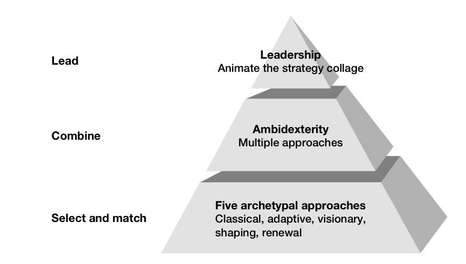
- Lead. Leaders can use it to shape the organization's approach to business. More about it towards the end of this article.
- Combine. Usually called ambidexterity, this combines multiple strategies at different levels of the organization.
- Select and match. A simple method of matching the business environment with viable strategies.
The strategy palette has five distinct approaches to strategy, which are as follows.
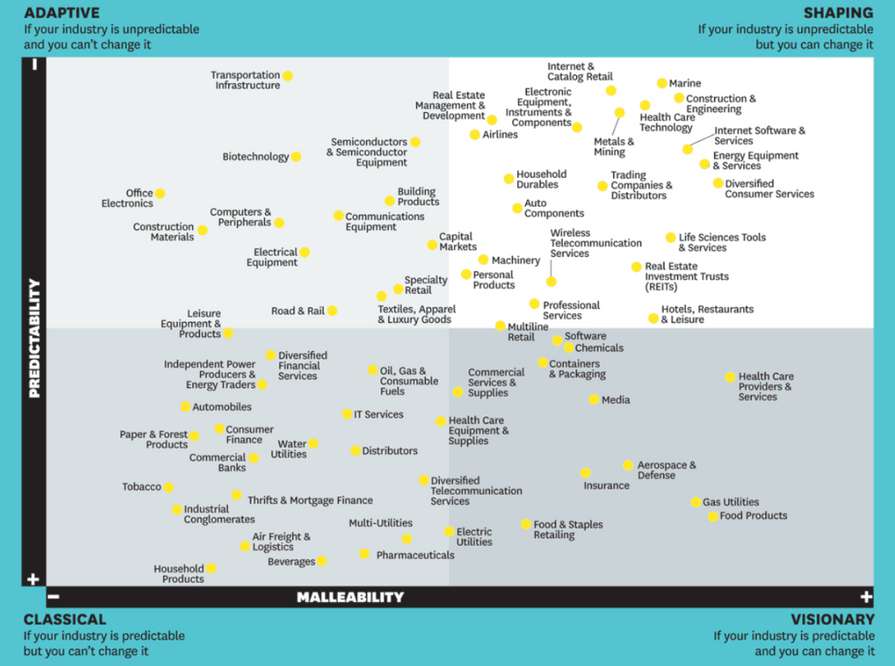
Classical strategy: be big
You are a young aspiring entrepreneur, looking to start an energy drinks business. What does your strategy look like? You analyze your target locations, which are gyms, jogging tracks, or maybe even the corporates. Great, now you set up a stall and start approaching people there and selling it to them. You just followed a classical approach to strategy. The classical approach thrives on three simple factors: analyze, plan, and execute. This is most suitable when your business is in a stable and predictable position. The classical strategy focuses on gaining a lasting competitive edge by positioning a company effectively within a desirable market.
Shell employs the classical strategy style by focusing on long-term, structured planning in the oil industry. This approach is built on a detailed analysis of economic factors related to demand and technological factors impacting supply. The company's strategy revolves around maintaining and strengthening its market position through careful resource allocation and efficiency improvements. Once established, these plans are typically stable and only adjusted when extraordinary events, such as major geopolitical shifts or operational disruptions, require it. This strategic style works well in industries like oil, where the environment is predictable but challenging to influence, enabling Shell to make informed, data-driven decisions to achieve long-term goals.
Adaptive strategy: be fast
In highly dynamic business environments, you need to keep experimenting to see what works best for your business. Focus on continuous experimentation and adjusting your approach in real time to see what's most feasible at the moment, rather than on long-term goals. Often the changes in planograms of the category, seasonality, competitive offerings, and substantial changes in shopper needs may signal that the brand needs an adaptive strategy.
When it comes to the clothing industry, Zara is a fashion powerhouse that blends the latest trends with fast, accessible style. Known for using the adaptive strategy by utilizing real-time sales data and customer feedback, Zara can quickly adapt its production and distribution strategies. This flexible approach enables Zara to swiftly react to shifting fashion trends, minimize excess inventory, and maintain a competitive edge in the ever-evolving fashion market.
Visionary strategy: be first
Think differently, said Apple, and so they did. Apple is a company that has consistently shaped and reshaped the way we use technology. Apple focused on breakthrough products, a unified ecosystem, and user-centric design as part of a visionary approach, as evidenced by the ground-breaking iPhone and iPod, which were one-of-a-kind products at the time they were launched. By being the first brand to introduce such innovative products, Apple was able to gain an early-bird advantage.
The visionary strategy is all about gaining the first-mover advantage. It's all about setting big-picture goals and trying to work towards them. Although rare, it is incredibly effective: a visionary approach empowers a firm to create or recreate an industry with some degree of predictability. While this kind of strategy is often associated with startups, large firms increasingly need to familiarize themselves with this approach as well.
Shaping strategy: be the orchestrator
You decided to start a YouTube channel and want it to be focused on making educational content for students. Now when you film, you don't just make videos based on what you think will be deemed useful and wait for reactions. Instead you go out there, conduct research, find topics that students are interested in, and then film content that caters to them. You don't wait for the change to happen; you drive the change. By shaping your channel's content and strategy, you attract more viewers and make a greater impact, and just like that you have made use of the shaping strategy.
This strategy is a little different compared to the others. While other strategies react to changes in the market, the shaping strategy involves proactively driving changes and creating opportunities in the market. Shaping firms influence and alter an industry by steering market development in their favor through collaboration with other stakeholders.
The founder of Salesforce.com, Marc Benioff, employed the shaping strategy to redefine his business, and Hagel, Brown and Davison use it as a leading example of a shaper in the Harvard Business Review. He used industry conferences to discuss transformative changes in the business environment, emphasizing that companies excelling in customer relationship management would gain a competitive edge. He proposed that customer-focused applications, such as sales force automation, should be delivered as network-based services rather than traditional on-site software. This model reduced IT costs and made updates easy. Within a decade of its founding in 1999, Salesforce.com had grown into a multi-billion-dollar company.
Renewal strategy: be viable
Back in 2008, the financial crisis had rocked the world, sending economies into a meltdown and businesses into bankruptcy. The world's biggest card issuer at the time, American Express, was no exception. American Express faced significant challenges, including decreased consumer spending and rising defaults. CEO Ken Chenault responded by cutting costs, reducing staff by 10%, and scaling back marketing. At the same time, he kept investing in the company's future. American Express worked on transitioning from a card-focused business to a broader financial services provider with a strong digital platform, expanding its membership rewards program. This is a renewal strategy, and it helped the share price recover from about $10 in March 2009 to about $40 by the end of that year.
These strategies are essential during challenging times, when a business model is no longer sustainable. It's critical for the company to recognize its most important priorities in these situations and modify its plan of action. Strategies for renewal are a company's response in times of trouble: an anticipatory reaction to hardship, with the goal of reviving the business. It's about revitalizing the company to improve its performance, adapt to new conditions, and secure future growth. By embracing change and innovation, businesses can navigate difficulties and emerge stronger than before.
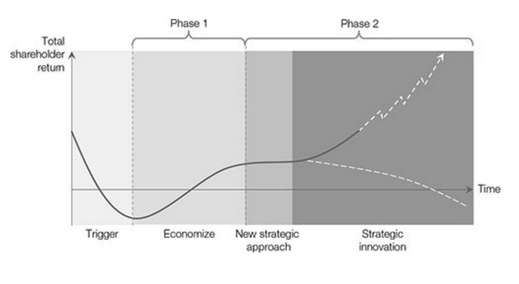
BCG describes renewal in two phases, one to survive and one to succeed again. Phase 1, economizing, is about recognizing the harshness of the environment and restoring the firm's financial viability. It should also free up enough funds to enable the firm's upward journey again. Phase 2, redirecting and implementing, is about correcting, planning and innovating a new strategy that focuses on scaling up and is oriented to the long term, as opposed to the short-term actions of the first phase.
Ambidexterity
Imagine you have some work and have to use both hands to accomplish the task. Sometimes you would work using your right hand or your left hand, and maybe even both hands simultaneously. This is what we refer to as ambidexterity in a day-to-day sense. But say an organization had a similar dilemma: what happens then?
The most widely used definition of ambidexterity is a balance between exploration and exploitation. Ambidextrous organizations can simultaneously explore new opportunities and capitalize on their current competencies. Businesses that operate in heterogeneous contexts, where many strategies must be implemented simultaneously, or in dynamic situations, where strategies must be changed over time, need to be ambidextrous. They need to be able to operate in both mature and emerging markets, integrate startups into their current operations, and bring new goods and technology to market while utilizing old ones, among a variety of other situations. Ambidexterity can be achieved through four distinct approaches.
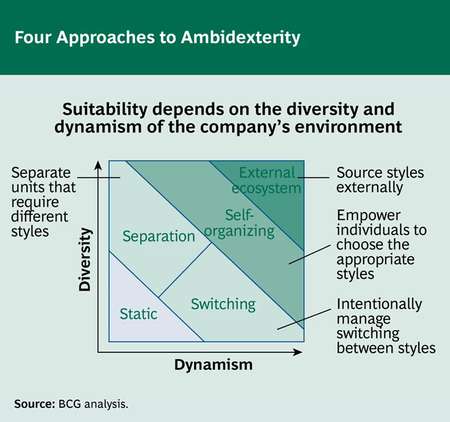
Separation approach. The simplest and most popular method for developing ambidexterity is separation, which is suitable for businesses operating in contexts that are dynamic but generally stable over time. It involves structurally separating units that need to deploy different strategy styles. For example, a company may decide to keep its developing business flexible and innovative while keeping its mature business efficient and disciplined in its execution.
Switching approach. This approach is most suitable for businesses operating in dynamic environments. Here, a business adapts its style over time in response to changes in its surroundings, much as startups do. An organization searching for a game-changing product, service or technology must first adopt an experimental style. But eventually, in order to grow and establish a lucrative market position, it has to adopt a more exploitative approach.
Self-organizing approach. A self-organizing strategy is required when a corporation needs to deploy numerous styles simultaneously and the styles are changing over time. Coordinating the switching process from the top down then becomes difficult and impractical. Businesses can develop self-organizing skills by segmenting their operations into smaller parts and establishing customized performance agreements.
External ecosystem approach. When there is a great deal of diversity and movement in the environment and it is difficult to generate the necessary variety of styles internally, businesses must use an external ecosystem strategy. Due to the significant expenses and hazards associated with collaboration, this strategy is only suitable in the most difficult situations.
Avoid these traps
The strategy palette comes from BCG's research, published as Your Strategy Needs a Strategy. In it, 90% of leaders agreed that a company needs to differentiate and adapt its approach to strategy as its environment changes. Yet there are several challenges in doing so, which the research groups into three broad types.
Misplaced confidence. One common trap that executives fall into is overestimating their control over the business environment. Many believe that by taking the right actions, they can manage uncertainty, when in reality many external factors remain unpredictable. In BCG's survey of more than 120 companies, about half of the executives thought they could control the uncertainties in their business through their own efforts. Even more striking, over 80% believed that reaching their goals depended more on their own actions than on external forces they couldn't influence. This misplaced confidence can lead to poor strategic choices, as it keeps executives from preparing for unpredictability.
Unexamined habits. Another trap is sticking to old habits, even when new approaches are needed. Many executives rely heavily on classical strategies, which they learned in business school or through experience. For example, around 80% of executives said they begin their strategic planning by setting a goal and then figuring out the best way to achieve it. However, in fast-changing environments, this approach may waste time on unrealistic predictions. Additionally, 70% of these leaders still value accuracy over speed, even when they know that quick, adaptive decisions are more effective.
Culture mismatches. The third trap is a company culture that clashes with the needs of adaptive strategies. Many organizations focus on efficiency and eliminating variation, which works well in stable environments. However, adaptive strategies require experimentation and learning from failure. In cultures where mistakes are heavily punished, trying new approaches becomes difficult. As a result, the potential benefits of adaptive and shaping strategies are lost in environments that prioritize short-term efficiency over long-term learning.
Lessons for leaders: be the animator
BCG identifies eight key roles for the leaders of a company. Above these roles, the leader of an ambidextrous firm must "manage a state of artful disequilibrium, often against the organization's natural tendencies."
In simpler terms, leaders must keep a constant read on the external as well as the internal environment, while making sure the company doesn't slip back into its natural tendencies at the wrong time. Leaders play an overarching role in animating the dynamic combination of strategic approaches.
Diagnostician. The leader's first important role is diagnosing each of the firm's current environments by assessing their degree of predictability, malleability and harshness, and then matching each part of the firm with the strategic approach it requires.
Segmenter. To match the right approach to each context, the organization needs to be segmented at the right level of granularity, balancing the trade-off between accuracy and complexity: the more segments, the more effort it takes to manage different approaches.
Disruptor. It is important not only to pick the right approach initially but to track changing circumstances and pivot to new approaches over time. The disruptor continuously reviews the diagnosis, the segmentation and shifts in the environment, to prevent the organization from becoming rigidly attached to an outdated recipe for success.
Team coach. Leaders set the right approaches and delegate the execution. As team coach, they select the right people to manage each cell of the strategy collage, since different approaches to strategy and execution require different skills and mindsets. They also help their team become fluent in the whole strategy palette, both intellectually and experientially.
Salesperson. Success depends not only on the right strategic approach and excellent execution but also on engaging internal and external stakeholders. The salesperson communicates the strategic choices as a whole, in a clear and coherent narrative, to investors and employees.
Inquisitor. Once leaders have selected the appropriate approach and assigned the right people to the job, they have to ask probing questions, not dictate answers, to stimulate the kind of critical thinking each approach calls for. In most areas, you have to "go an inch deep and a mile wide, but go a mile deep on areas where you don't believe [the organization] has the skills," says Indra Nooyi of PepsiCo.
Antenna. After leaders have selected the approach for each unit, they help execution by keeping the organization in tune with the external environment. To do so, they continuously look outward and selectively amplify important signals.
Accelerator. Finally, it's the accelerator's role to put weight behind select critical initiatives to speed up or bolster their implementation, especially when the required approach has changed, is unfamiliar, or is likely to be resisted by the organization.
References
- Reeves, Love and Tillmanns, Your Strategy Needs a Strategy, Harvard Business Review, 2012, and the Harvard Business Review Press book of the same name
- BCG, The strategy palette
- BCG, Shaping and Renewal
- BCG, Ambidexterity: the art of thriving in complex environments, 2013
- Hagel, Brown and Davison, Shaping Strategy in a World of Constant Disruption, Harvard Business Review, 2008
- Martin Reeves, Why leaders need to be animators, LinkedIn
- MIT Sloan Management Review, Building ambidexterity into an organization
- London Business School, Organisational ambidexterity
- Torii, Renewal strategy
- Forbes, Who is Kenneth Chenault?, 2024
- LinkedIn, Future-proofing your business: how adaptive strategy can help