Saudi Arabia’s diversification strategies: transforming the economy beyond oil
By A. Aravind and Ankith Bharadwaj. First published in AXON (Volume 1, Issue 2, September 2024), the newsletter of Synapse, the strategy and data analytics club at CHRIST University, Bengaluru. Figures are as of 2024.
Introduction
Saudi Arabia's economic diversification strategy is one of the most ambitious transformations currently underway in the global economic landscape. For decades, the Kingdom has relied heavily on its oil exports, with the energy sector contributing the majority of its government revenue. However, recognizing the volatility of global oil markets, the environmental impacts of fossil fuels, and the need to secure a sustainable future for its economy and citizens, Saudi Arabia launched its Vision 2030 program in 2016. This comprehensive plan aims to reduce the nation's dependence on oil and cultivate other sectors to generate new revenue streams, create jobs, and modernize its infrastructure.
The motivation behind this diversification stems from several factors. Global demand for renewable energy is rising, putting pressure on oil-dependent economies to find other ways to thrive. Fluctuations in oil prices have also historically caused economic instability, highlighting the risks of over-reliance on a single commodity. In this context, Vision 2030 marks a strategic pivot toward a more resilient and dynamic economy, with sectors such as tourism, entertainment, finance, technology and manufacturing playing a central role.
At the heart of Saudi Arabia's diversification efforts is the Public Investment Fund (PIF), a sovereign wealth fund that invests in both domestic and international projects. The government has also launched large-scale initiatives like NEOM, an ultra-modern megacity powered by clean energy, as well as reforms aimed at encouraging foreign investment and improving the ease of doing business in the Kingdom. As Saudi Arabia continues its journey towards diversification, challenges such as workforce development, cultural shifts and global competition will need to be addressed. However, if successful, the Kingdom's efforts could serve as a model for other resource-dependent nations seeking to future-proof their economies.
Saudi Arabia's oil dependency
Saudi Arabia's economic history is deeply intertwined with its vast oil reserves, which have shaped its development and global influence for much of the 20th and 21st centuries. Oil was first discovered in the Kingdom in 1938 at the Dammam oil field in the Eastern Province, marking the beginning of a new era for the country. This discovery turned Saudi Arabia from a largely desert-based economy with limited resources into one of the most critical players in the global energy market.
The 1970s oil boom was a defining moment for Saudi Arabia, as the country's oil production surged and global prices skyrocketed due to geopolitical events like the 1973 Arab-Israeli War and the oil embargo that followed. This unprecedented influx of wealth transformed the nation's infrastructure, lifestyle and international standing. Revenues from oil exports allowed Saudi Arabia to fund massive development projects, modernize its cities, invest in public services, and improve its education and healthcare systems. Saudi Arabia was also a founding member of the Organization of the Petroleum Exporting Countries (OPEC) and an influential voice within it, further cementing its status as a global oil giant.
However, this deep reliance on oil also created vulnerabilities. More than 90% of Saudi Arabia's government revenue has historically come from oil exports, making the economy highly susceptible to fluctuations in global oil prices. Periods of price crashes, such as in the 1980s and during the 2008 global financial crisis, exposed the limitations of an oil-dependent economy. And as the world began transitioning towards renewable energy and sustainability, the risks of depending so heavily on a single, finite resource became more apparent.
Oil dependence also influenced Saudi Arabia's social and political structures. The wealth generated by oil allowed the government to implement a social contract, providing generous subsidies, social benefits and state-funded employment to its citizens in exchange for political stability and loyalty. However, as global markets became more volatile, the strain of maintaining this model increased, emphasizing the need for economic reform and diversification. Recognizing these challenges, Saudi Arabia has embarked on a significant shift in recent years, aiming to reduce its reliance on oil and build a more sustainable, balanced economy through its Vision 2030 plan. This pivot marks a critical juncture in Saudi Arabia's economic history, as it prepares for a post-oil future while dealing with the challenges and opportunities of its long-standing reliance on hydrocarbons.
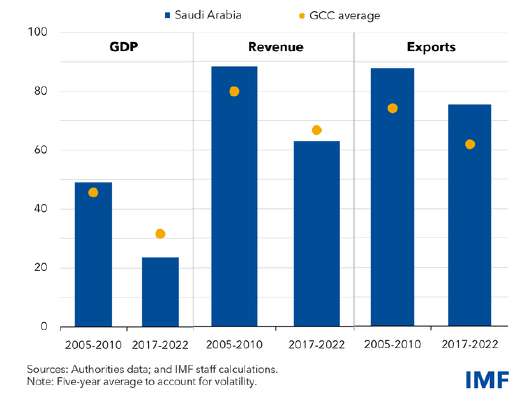
Saudi Arabia has been highly dependent on oil, with oil revenues accounting for a large share of the country's GDP and government spending:
- Oil economy: between 1970 and 2000, oil made up 30-60% of Saudi Arabia's GDP.
- Oil revenues: in 2024, oil accounted for about 63% of Saudi Arabia's government revenue.
- Government spending: the government relies heavily on oil revenues for both current and capital spending.
- Economic growth: government spending drives growth in non-oil and private-sector activity.
Saudi Arabia's Vision 2030
Vision 2030 was launched in 2016 by Crown Prince Mohammed bin Salman. Its primary objective is to reduce Saudi Arabia's dependency on oil and diversify the economy. It rests on three pillars:
- A vibrant society: enhancing quality of life, cultural identity and tourism.
- A thriving economy: diversifying the economy, fostering innovation and creating jobs.
- An ambitious nation: government transparency, efficiency and citizen participation.
Its economic goals are:
- diversifying revenue away from oil and into non-oil sectors;
- increasing foreign direct investment (FDI) and private-sector participation;
- expanding non-oil exports and reducing the fiscal deficit;
- growing small and medium-sized enterprises (SMEs) from 20% to 35% of GDP.
The major sectors targeted for growth are:
- Tourism and entertainment: increasing domestic and international tourism through projects like NEOM and the Red Sea developments.
- Technology and innovation: investing in advanced technologies, digital infrastructure and smart cities.
- Healthcare: expanding and improving healthcare services with private-sector involvement.
- Renewable energy: producing 50% of the country's energy from renewables by 2030.
- Financial services: turning Saudi Arabia into a global financial hub through reforms in capital markets.
And its key initiatives are:
- Public Investment Fund (PIF): a sovereign wealth fund aiming to manage over $2 trillion by 2030, investing in both domestic and international projects.
- NEOM: a futuristic, $500 billion megacity powered by renewable energy, focused on innovation, smart technologies and sustainability.
- Red Sea Project: a luxury tourism destination being developed along Saudi Arabia's western coastline.
- Saudi Green Initiative: environmental sustainability, including planting billions of trees and reducing carbon emissions.
The Public Investment Fund
The Public Investment Fund is the sovereign wealth fund of Saudi Arabia. It is one of the largest sovereign wealth funds in the world, with assets under management of about $925 billion as of July 2024. Through it, the Saudi government diversifies its assets, investing in projects and assets across the world on behalf of Saudi citizens.
The PIF plays a vital role in moving Saudi Arabia's wealth into non-oil sectors. It holds investments in sectors such as healthcare and technology, which are crucial to ending Saudi Arabia's dependence on its oil reserves.
Over 60% of its investments are within Saudi Arabia, aimed at turning the country into a global business hub. With megaprojects such as NEOM and Qiddiya, these investments aim to make Saudi Arabia a futuristic destination that draws investment from other countries.
The PIF also keeps a portfolio of international assets. Football fans might have noticed its purchase of Premier League club Newcastle United in 2021. It has also made major investments in technology companies like Uber, Tesla and Lucid Motors to gain exposure to future technologies. The fund has been very successful so far, making a profit of $36.81 billion in 2023.
Long-term prospects of this strategy, and conclusion
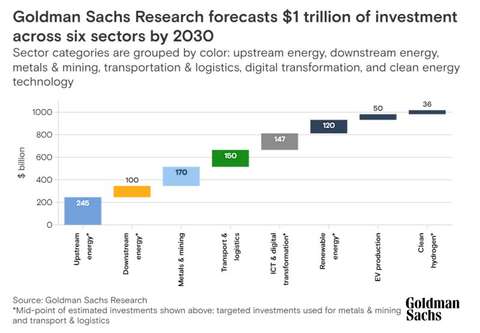
Saudi Arabia's diversification strategy has been quite promising, thanks to strategic investments, policy reforms and a focus on non-oil sectors. Ever since the launch of Vision 2030, the Saudi government has been steering vast sums into new sectors. It launched the National Investment Strategy in 2021, and Goldman Sachs Research forecasts about $1 trillion of investment across six sectors by 2030: upstream energy, downstream energy, metals and mining, transport and logistics, digital transformation, and clean energy technology. The government also plans to spend $870 billion on megaprojects like NEOM to make Saudi Arabia a worldwide hub for business.
Through these strategies, Saudi Arabia expects its non-oil exports to grow from 16% to 50% of non-oil GDP by 2030, helped by its Shareek program, which invests in the private sector. It has also introduced policy reforms to make the country a tourist hotspot and a conducive environment for business, along with progressive reforms such as allowing women to drive and granting maternity leave and employment rights, aimed at improving its image abroad.
However, this strategy isn't without its critics, and economists have questioned it for several reasons. Even after the rapid diversification efforts, oil still accounted for about 60% of government revenue and 42% of GDP as of 2024, indicating a heavy reliance on oil. The economy is still driven by oil revenue and government spending, which raises questions about the strategy's success. It has also struggled to attract much foreign direct investment, owing to scepticism in Western media and an overall negative perception. The government has been criticised for a long list of human rights violations and a lack of gender equality: in 2024 Saudi Arabia ranked 126th out of 146 countries in the World Economic Forum's Global Gender Gap Index and scored 8 out of 100 in Freedom House's Freedom in the World report.
In short, Saudi Arabia is on the right track in diversifying beyond oil, but questions remain about how effective the strategy is, and whether its progress is driven by anything more than government spending.
Sources
- Government of Saudi Arabia, Vision 2030
- Royal Embassy of Saudi Arabia, Vision 2030
- Wikipedia, Saudi Vision 2030
- IMF, Saudi Arabia's economy grows as it diversifies, 2023
- Goldman Sachs, How Saudi Arabia is investing to transform its economy
- Harvard Kennedy School, Diversifying an oil-based economy in Saudi Arabia, 2024
- Zawya, PIF's assets under management rise to $925bln by July 2024
- Asia Asset Management, Saudi Arabia wealth fund PIF posts US$36.81 billion net profit in 2023
- World Economic Forum, Global Gender Gap Report 2024
- Freedom House, Saudi Arabia: Freedom in the World 2024